%3F%20Understanding%20it%20correctly%20for%20effective%20application%20in%20business.?unique=e0c36b5)
Why is it necessary to understand AI again, from the very beginning?
Nowadays, AI is increasingly present in business operations, from customer service chatbots and product recommendation systems to demand forecasting tools and decision support in finance. The frequent mention of AI gives many people the impression that AI has become a familiar part of business life. However, this familiarity can easily lead to a simplistic and incomplete understanding of AI.
Many businesses view AI as an "off-the-shelf smart solution," expecting that simply purchasing it will allow them to use it immediately and that the technology will automatically resolve existing issues. When the implementation results do not meet expectations, the cause often lies not in the AI itself, but in the fact that the business has set incorrect expectations about its role. Therefore, it is essential to revisit and correctly understand the nature of AI from the beginning, to help businesses avoid implementing technology as a trend without a clear strategic direction.
What is artificial intelligence (AI)?
Artificial intelligence is a technology that allows machines to simulate some of the capabilities of humans, such as the ability to learn, process information, identify problems, and assist in decision-making. This approach helps AI no longer be an abstract concept, but rather be connected to familiar activities in people's daily work.
From a business perspective, instead of viewing AI as a complex algorithmic system, it can be understood as a tool that helps process large volumes of data more quickly, detect underlying trends more clearly, and assist managers in assessing situations more accurately in a volatile environment. AI can recognize images, process human language, learn from new data, and provide suggestions within a predefined scope.
It is important to emphasize that AI does not operate freely or independently. It is designed, trained, and constrained by humans. AI learns from data provided by humans, operates according to goals set by humans, and serves the purposes of organizations. Therefore, the ultimate responsibility for the results produced by AI still lies with humans, not with the technical system.
What is the difference between AI and traditional automation?
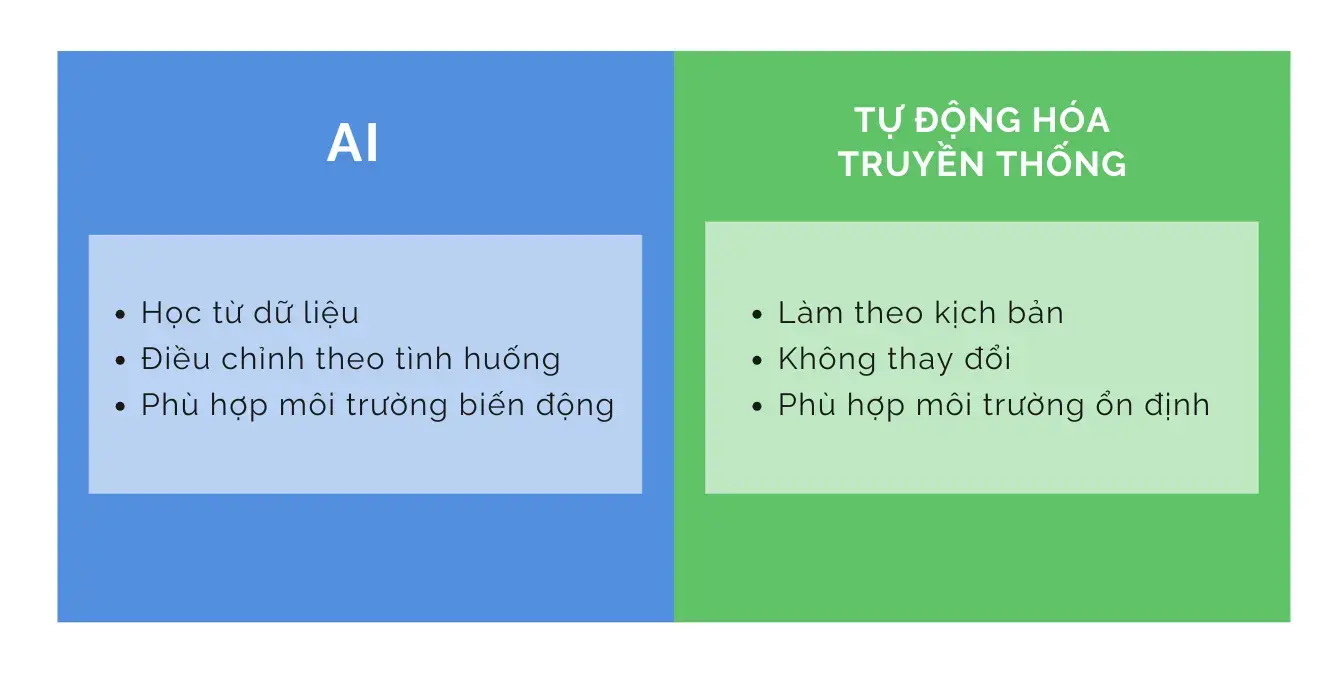
A common misconception in many businesses is that AI is just a form of advanced automation. In reality, traditional automation only performs pre-programmed steps, with the advantage of being fast and accurate, but it lacks the ability to change how things are done when the context changes.
AI is different in that it can learn from new data and adjust its behavior over time. For example, an automated production line simply repeats pre-designed operations, while an AI system can learn from product defect data to improve the quality control process. This ability to learn is what makes AI suitable for today's business environment, where market demands and customer behaviors are constantly changing.
Therefore, AI not only helps businesses optimize existing processes but also helps them adapt better to market uncertainties. In other words, AI not only helps to do things faster but also helps to do them more flexibly.
The value of AI to businesses
AI brings many benefits to various business activities, from operations to management. The benefits often mentioned include automating repetitive tasks, processing data faster, supporting decision-making, reducing errors, and maintaining continuous operations.
In fact, a chatbot system can handle thousands of customer requests each day; a demand forecasting model can help businesses adjust their inventory appropriately; and a data analytics tool can assist managers in identifying trends that personal experience may struggle to detect. AI thus not only helps businesses "work faster," but also helps them "work more steadily."
As decisions increasingly rely on data, organizations can reduce their dependence on intuition and immediate pressure. At the same time, automating repetitive tasks also gives workers more time for evaluative, creative, and higher-responsibility tasks. From this perspective, AI is seen as a layer of support for humans, rather than a force that completely replaces them.
AI as a component of the decision-making system
When AI is implemented in management operations, its role goes beyond just automating technical tasks; it is increasingly involved in the decision-making process. The familiar chain of "data - humans - decisions" is gradually being expanded to "data - AI systems - humans - decisions."
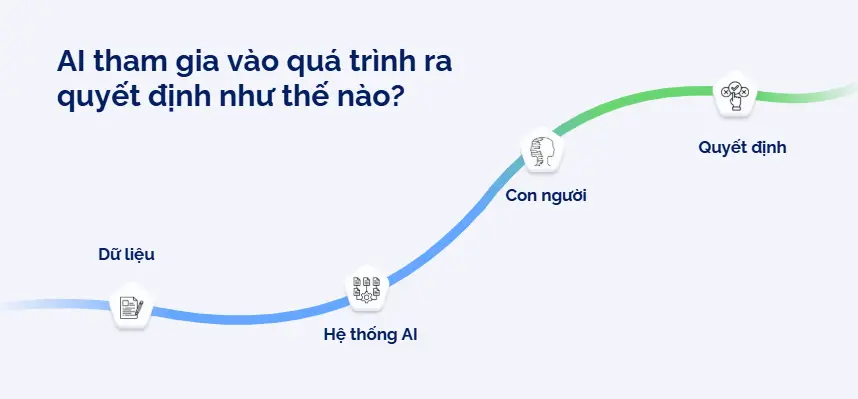
In this model, AI takes on the role of processing and analyzing data first, then providing suggestions for human consideration. Through machine learning models, AI can detect relationships in the data that are difficult for humans to recognize, forecast future trends, and propose appropriate courses of action. The options provided by the system will become prominent choices, while unmodeled possibilities may be overlooked by decision-makers.
Many people believe that AI is objective because it is based on data. However, in reality, every AI system reflects the initial choices made by humans, from the data used for training to the goals that the system optimizes. These choices are inherently governance and value-based, not just technical issues.
When AI is used for credit assessment, customer classification, or screening job applications, it not only processes information but also indirectly shapes human opportunities. Additionally, when AI systems frequently make recommendations with high accuracy, people tend to trust the system more and verify less. In the long run, this dependence can diminish independent analytical capabilities and a sense of responsibility within the organization. At that point, AI not only supports humans but also influences how people think and act in management.
Challenges and Risks of AI
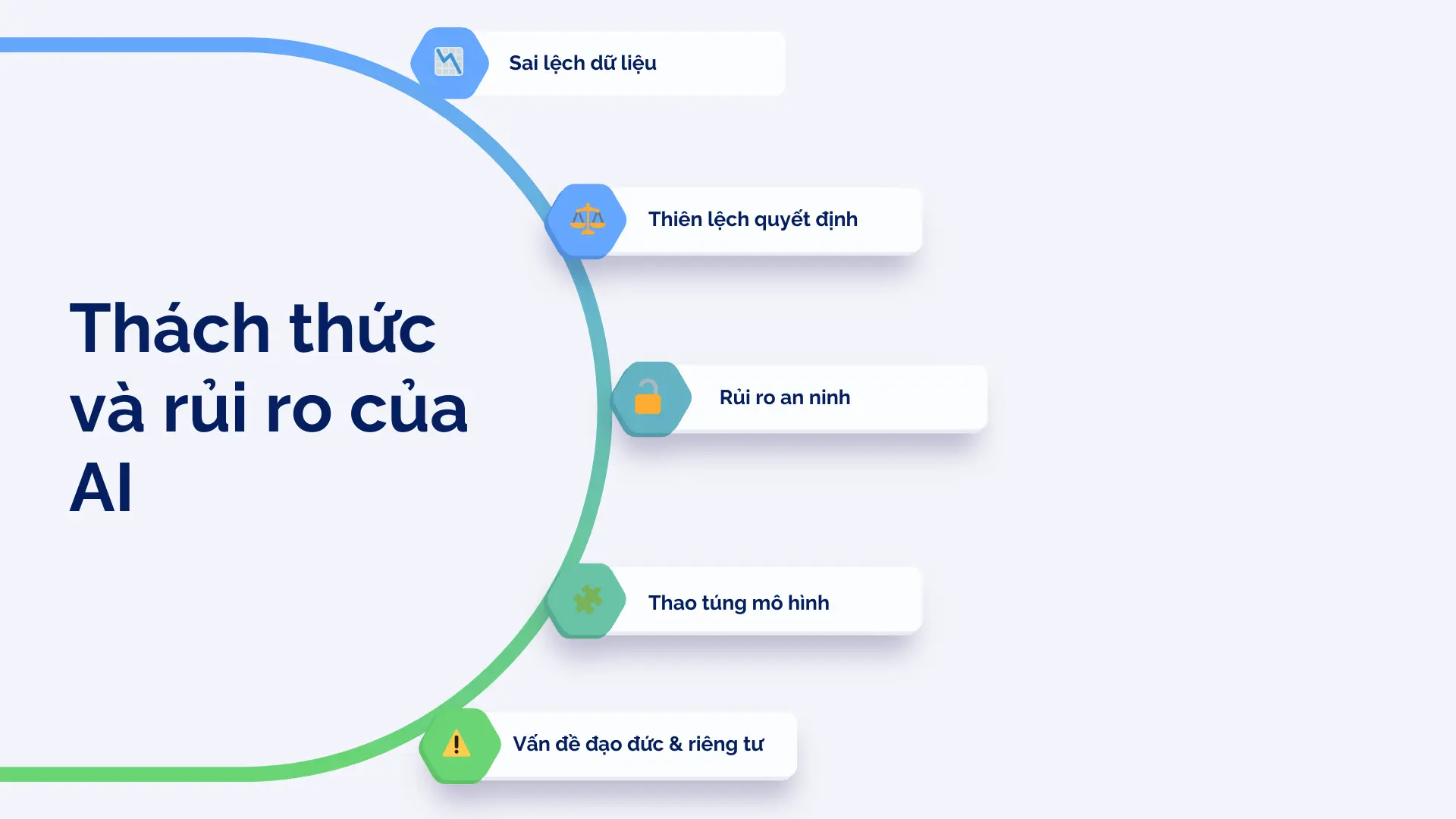
Implementing AI always comes with certain challenges. Since AI heavily relies on data, if the data is incomplete, biased, or manipulated, the results produced by the system will also be affected. These biases not only lead to incorrect decisions but can also spread on a large scale.
Furthermore, as AI becomes a critical asset, it also becomes a target for attacks. The theft of models, interference with data, or sabotage of systems is not just a technical issue, but also a matter of security and business strategy. More importantly, if businesses do not pay attention to ethical considerations and privacy, AI can lead to violations of personal data or produce discriminatory outcomes.
At that point, the issue is no longer about the accuracy of the algorithm, but rather about the organization's governance capacity in monitoring, controlling, and using technology responsibly.
Conclusion
AI is not a "magic wand" that can solve every problem, but rather a powerful tool. When implemented correctly, AI helps businesses enhance forecasting capabilities, improve decision-making quality, and optimize operational activities. However, this very power also imposes higher demands on management capabilities, strategic thinking, and control mechanisms.
Ultimately, AI does not replace humans in taking responsibility for decisions. On the contrary, it highlights a core reality: no matter how intelligent technology is, its true value still depends on how humans design, implement, use, and govern it responsibly and sustainably.
This article is an in-depth content belonging to the Digital Transformation topic of RIDE. For a comprehensive and systematic view, please refer to: Digital Transformation of Enterprises: A Comprehensive Guide from Strategy to Implementation
Reference source
- IBM. What is artificial intelligence (AI)?
- IBM. Benefits and risks of artificial intelligence.