
Vietnam is at a crucial turning point in its digital transformation journey. In recent years, a series of new policies and laws related to science, technology, and innovation have been enacted, along with the emergence of strategic technologies prioritized for domestic development. Notably, discussions about AI philosophy—a topic that seemed distant in previous years—have now become a focal point in the management plans of leaders. These changes indicate that Vietnam's digital transformation is not merely about technology application, but rather a process of institutional building, capacity development, and ideological creation for a rapidly changing society.
The starting point of this process is the legal system. The law serves as the foundation for all transformation activities. However, the institutional gaps during the implementation phase have become quite apparent. Ms. Nguyễn Như Quỳnh, Director of the Legal Department of the Ministry of Science and Technology, pointed out that "The law is in effect but lacks decrees and guiding circulars, which causes confusion for agencies, organizations, and businesses during implementation."
Source of the referenced article: "Do not let the laws on science and technology wait for decrees and circulars – VNExpress"
Ms. Nguyễn Như Quỳnh at the regular press conference of the Ministry of Science and Technology, December 2025. Photo: Thùy Linh
In reality, when the guiding documents are delayed in issuance, innovative initiatives are easily stalled right from the start. Businesses do not know how to apply the law to benefit from incentives, research institutions lack mechanisms for technology transfer testing, and regulatory agencies do not have a basis for evaluating results. In the technology environment, this delay has greater consequences compared to traditional industries, as the technology life cycle is short, the pace of innovation is rapid, and competitive opportunities arise within a limited timeframe.
From the perspective of the Institute for Research on Organizations and Digital Economy, the solution lies not only in the faster issuance of subordinate legal documents but also in designing a more flexible policy system. A legal sandbox model—where businesses can trial new products within a controlled risk scope—will be a necessary tool to bridge the gap between regulation and innovation. Additionally, policy should shift from a "license first - implement later" mindset to a "controlled implementation - gradual adjustment" approach, in line with the characteristics of technology.
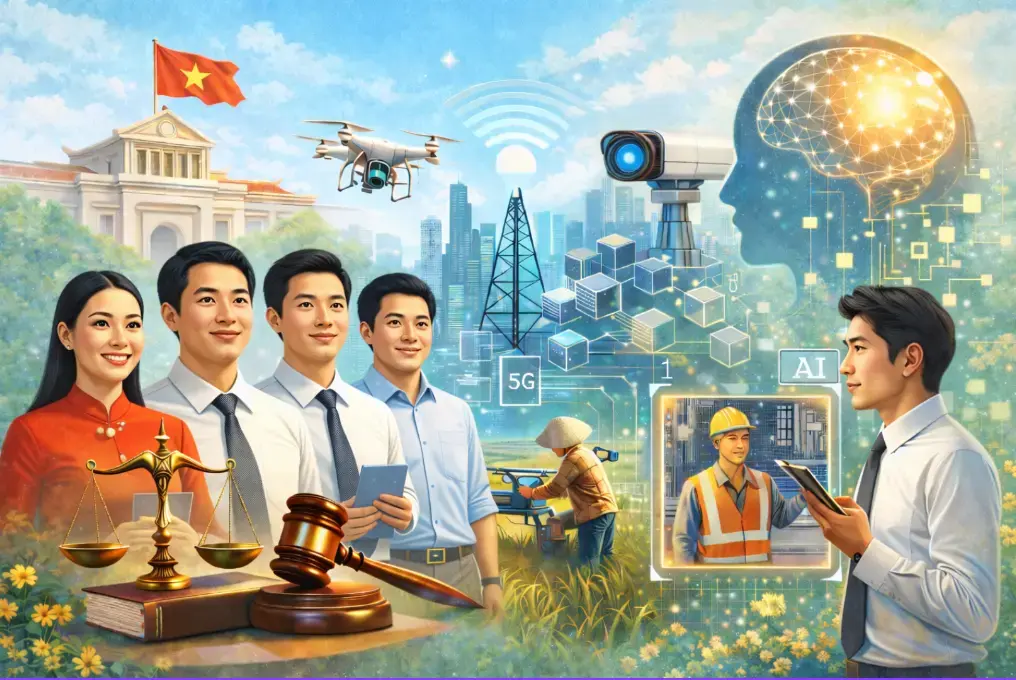
If the institution is the foundation, technology is the driving tool. The government's identification of six priority technologies for implementation – including virtual assistants, autonomous robots, UAVs, 5G, AI cameras, and blockchain networks – reflects a clearly calculated choice regarding national vision and capabilities.
Source of the reference article: "Six strategic technologies to prioritize for immediate implementation – VNExpress"

Engineers are testing the 5G base station developed by Vietnam. Photo: Trong Dat
These technologies all share three characteristics: a wide range of applications, the ability to reduce the technology gap with advanced countries, and the potential to form new economic sectors. In agriculture, UAVs combined with AI can create precise agricultural products, reduce input costs, and increase productivity. In industry, 5G and autonomous robots help automate processes and optimize operational capacity in factories. In urban areas, AI camera data can reduce monitoring costs and enhance labor safety. Meanwhile, blockchain is becoming the new trust foundation for transparency in supply chains and the commercialization of agricultural products.
However, according to the Institute's assessment, this strategic choice will only succeed if it is transformed into actual market capabilities. This requires three conditions: the domestic research and development ecosystem must be invested in the right direction, businesses must become the entities that order technology rather than just receiving it, and there must be policy mechanisms that encourage the commercialization of knowledge. One existing risk is that large enterprises will seize opportunities more quickly while small and medium-sized enterprises may be left behind due to a lack of investment capacity. Therefore, infrastructure sharing programs, joint investment funds, or technology alliances between large enterprises, startups, and research institutes are options that need to be considered.
Unlike the two tangible pillars of institutions and technology, the third pillar – the philosophy and thought of AI – is foundational but often overlooked in public discussions. Minister Nguyen Manh Hung emphasized, “Science answers the question 'what can we do,' but philosophy helps answer the larger question 'what should we do' in the age of AI.” This statement raises a core issue: a technological system is only truly powerful when it is accompanied by a value system that defines what it operates for.
Source of the reference article: "Minister Nguyen Manh Hung: Vietnam should have a philosophy about AI – VNExpress"

Minister of Science and Technology Nguyen Manh Hung shared at the Institute of Philosophy on the afternoon of January 6. Photo: TTTT
In the context where AI can make predictions, suggest behaviors, or make decisions on behalf of humans, questions about technology ethics, privacy, the right to refuse algorithms, and legal responsibility become unavoidable. According to the Institute, incorporating AI philosophy into policy discussions is a pioneering step for Vietnam in the region, and if implemented systematically, it will help Vietnam develop technology on a responsible and humane foundation.
Observing from a systemic perspective, these three pillars are creating noticeable changes in economic and social life. Digital infrastructure is expanding rapidly, domestic technology companies are significantly increasing in number and scale, and many traditional economic sectors are beginning to adopt new technologies to optimize production. However, the ecosystem still faces several barriers: a lack of high-quality human resources, a gap between research and practical application, and a risk-averse mentality in technology investment.
From the perspective of the Institute for Research on Organizations and Digital Economy, three clear action directions are needed. First, enhance training and development of human resources in an interdisciplinary manner, combining technology – management – data ethics. Second, establish a mechanism for technology ordering between the state – enterprises – academic institutions, considering this as the main driving force for domestic technology to have room for development. Third, create policy and technology testing spaces at the urban, industry, or local level, where new models can be validated before being scaled up.
The digital transformation of Vietnam, if guided by timely institutions, the right focus on technology, and a clear directional mindset, will not only help the country keep pace with global trends but also open up opportunities for deeper participation in the international technology ecosystem. The road ahead still holds many challenges, but emerging signals indicate that Vietnam is shifting from a mindset of "receiving" to "creating," from using technology to self-defining its role in the AI era.
Read the following articles to further strengthen your comprehensive perspective

Minister Nguyen Manh Hung: "Vietnam should have a philosophy about AI"
Science answers the question "what can we do," but philosophy helps answer the bigger question "what should we do" in the age of AI, according to Minister Nguyen Manh Hung.
The message was delivered by Minister of Science and Technology Nguyen Manh Hung during a working session with the Institute of Philosophy, part of the Vietnam Academy of Social Sciences, on the afternoon of January 6. During more than three hours of work, he and leaders from several units in the Ministry spent most of the time listening to shares, answering questions, and addressing some issues in the field of philosophical research in particular and social sciences in general in Vietnam.
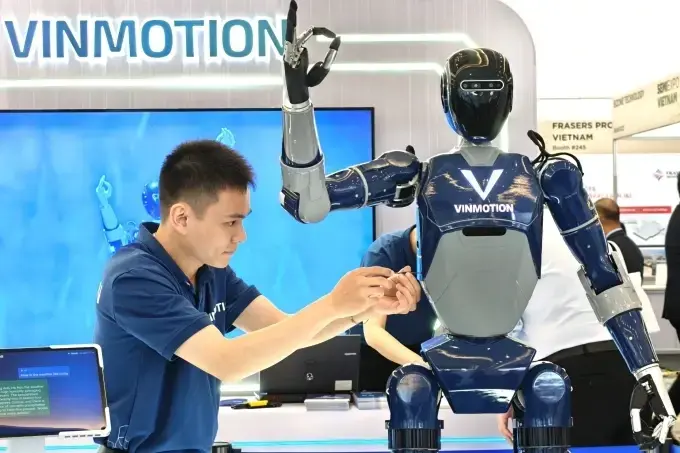
Six priority strategic technologies for immediate deployment
"Virtual assistants, autonomous robots, UAVs, 5G, AI cameras, and blockchain networks are strategic technology products that the government prioritizes for immediate implementation."
The Prime Minister has just approved the national science, technology, and innovation program for the development of priority strategic technology products to be implemented immediately.

Do not let the laws on science and technology wait for decrees and circulars
"The Ministry of Science and Technology is urgently drafting decrees and circulars to guide 5 new laws, issued simultaneously with the laws that have been passed and are in effect, according to Ms. Nguyen Nhu Quynh."
Tiếp tục đọc Follow RIDE to better understand how to operate in the digital age!
Do you want to enhance your knowledge about digital transformation, innovation, and artificial intelligence?
Contact