
What is digital transformation in business?
Digital transformation in enterprises is the process of applying digital technology, data, and digital platforms to all operational activities to enhance management efficiency, optimize costs, and create new business models. Unlike digitization, which only converts data from physical form to digital form, digital transformation requires a comprehensive change in operational processes, organizational models, and how businesses make data-driven decisions. Therefore, digital transformation is not just a technological issue but also a process of changing strategy, management thinking, and organizational culture. In the context of a rapidly developing digital economy, digital transformation increasingly becomes an important factor that helps businesses enhance their competitive capacity, increase adaptability to market fluctuations, and build a foundation for sustainable growth.
Why do businesses need to undergo digital transformation in the context of the digital economy?
The rapid development of digital technology is changing the way businesses operate, compete, and create value. Digital platforms, big data, and artificial intelligence enable businesses to make decisions faster, more accurately, and optimize many business operations. In an increasingly competitive environment, companies that are slow to undergo digital transformation often face difficulties in improving operational efficiency, enhancing customer experience, and expanding their market. The digital transformation process also facilitates the formation of new business models based on digital platforms, increases connectivity with partners and customers, and enhances long-term innovation capabilities.
The benefits of digital transformation for businesses
The implementation of digital transformation brings many strategic benefits to businesses. Digital systems help automate many operational processes, reduce processing time, and limit manual errors, thereby enhancing operational efficiency and labor productivity. Leveraging business data, customer data, and operational data helps businesses gain a better understanding of internal operations as well as market demands, allowing them to make timely and appropriate business decisions. Digital transformation also helps businesses expand their markets through e-commerce platforms and digital service channels, facilitating the development of new products, services, and business models. These benefits not only provide short-term effectiveness but also contribute to building sustainable competitive advantages in the long term.
Core technologies in digital transformation of enterprises
Digital transformation in businesses is driven by the development and integration of various digital technologies, among which artificial intelligence (AI), the Internet of Things (IoT), and big data analytics are considered the three most important foundations. Businesses that effectively leverage these technologies often have the ability to enhance productivity, optimize operations, and increase their agility in responding to market changes.
Artificial intelligence (AI) plays a crucial role in data analysis, trend forecasting, and automating many business processes. This role is analyzed in detail in the article "Artificial Intelligence (AI) in Business: Role, Value, and Implications for Management." The Internet of Things (IoT) allows businesses to connect and monitor devices, production lines, or logistics systems in real-time. The practical applications of this technology are presented in the article "What is IoT and IoT Applications in Manufacturing." Meanwhile, big data analytics helps businesses extract value from the increasing volume of data, supporting the development of growth strategies and optimizing business operations. The combination of AI, IoT, and big data analytics creates a foundation for a data-driven business model, where data becomes a strategic asset for management and innovation in operational models.
Effective Digital Transformation Roadmap for Enterprises
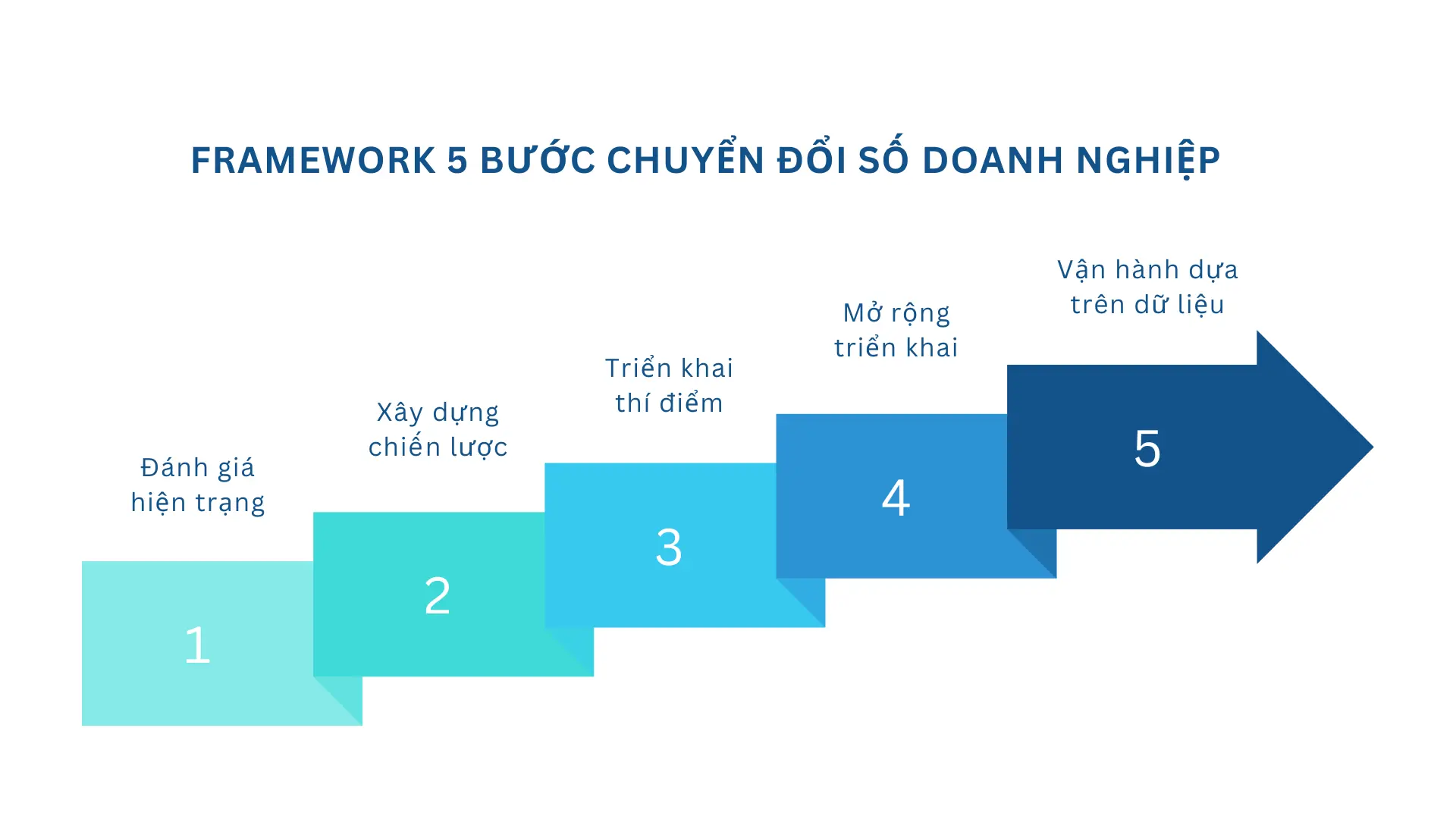
The digital transformation roadmap is typically implemented in 5 phases, including: assessing the current state, developing a strategy, piloting, scaling up implementation, and operating based on data. Implementing in phases helps businesses reduce investment risks, validate effectiveness, and optimize resources before expanding organization-wide.
In the initial stage, businesses need to assess their readiness for digital transformation, including technology infrastructure, data systems, operational processes, and human resource capabilities. The assessment results help identify gaps that need improvement and prioritize areas for implementation to achieve quick results. This content is detailed in the article "Model for Assessing Business Digital Transformation Readiness." Based on the current status assessment, businesses develop a comprehensive digital transformation strategy with specific goals, performance measurement indicators, and a phased implementation roadmap aligned with business objectives. Pilot projects should be implemented in certain departments or key processes to validate effectiveness before expanding organization-wide. When pilot projects yield positive results, businesses can scale up implementation while building a unified data platform and training personnel to ensure sustainable operational capability. Monitoring and measuring effectiveness through KPI indicators throughout the implementation process helps businesses adjust strategies and optimize results.
The current state of digital transformation in enterprises in Vietnam
In Vietnam, the digital transformation of enterprises is entering an acceleration phase driven by the national digital transformation strategy. In recent years, the digital transformation process has recorded significant progress, as evidenced by the rapid growth rate of the digital economy and the increasingly widespread application of technology in business operations. The proportion of Vietnam's digital economy is estimated to reach about 18.3% of GDP in 2024 and continue to maintain a growth rate of over 20% each year, placing it among the countries with a high digital economy development rate in Southeast Asia. Vietnam currently has more than 850,000 active enterprises, of which over 98% are small and medium-sized enterprises. This sector contributes about 45% of GDP and more than 60% of total employment in the economy, highlighting the crucial role of small and medium-sized enterprises in the national digital transformation process. Therefore, the readiness for digital transformation of this group of enterprises is crucial for the overall effectiveness of the digital transformation of the entire economy.
However, the process of implementing digital transformation among businesses is still uneven. Many companies, especially small and medium-sized enterprises, face difficulties due to limitations in financial resources, a lack of skilled technology personnel, and challenges in integrating new technology systems with existing infrastructure. The reality shows that the digital transformation gap between large enterprises and small and medium-sized enterprises remains significant, reflecting disparities in technological resources, data capabilities, and long-term investment potential. In the upcoming period, enhancing data management capabilities, developing digital skills for the workforce, and building an ecosystem to support digital transformation for small and medium-sized enterprises will play a crucial role in narrowing this gap.
Challenges in Implementing Digital Transformation in Enterprises
Although digital transformation brings many benefits, the implementation process often encounters numerous barriers related to strategy, resources, and organizational capabilities. Most difficulties do not stem from a lack of technology but from the fact that businesses are not adequately prepared in terms of strategy, data, and personnel for synchronized implementation. Many companies have not developed a comprehensive digital transformation strategy, leading to the implementation of fragmented technology solutions that are not aligned with long-term business goals. When there is a lack of clear direction, businesses can easily fall into a state of dispersed investment, where costs increase but the effectiveness is limited. Constraints in financial resources and technology personnel are also common barriers, especially for small and medium-sized enterprises. Implementing data systems, analytics, and automation requires significant initial investment costs, while many businesses do not have a skilled workforce to effectively operate and leverage digital platforms. Difficulties in integrating existing technology systems with new platforms also increase the complexity of the implementation process, extending the timeline and incurring additional costs. At the same time, human factors and organizational culture play a crucial role as digital transformation requires changes in work methods, operational processes, and data-driven decision-making. If not well-prepared in terms of digital skills training and building a culture ready for change, digital transformation projects often struggle to achieve the expected effectiveness.
Common mistakes when implementing digital transformation in businesses
In fact, many businesses fail due to common mistakes when implementing digital transformation. These mistakes are analyzed in detail in the article "5 Common Mistakes in Applying Digital Transformation in Small and Medium Enterprises." While the challenges reflect the conditions of implementation, many businesses also face difficulties due to inappropriate implementation decisions. One common mistake is focusing on technology investment without adjusting the corresponding operational processes and governance models, causing the new system to not perform as expected. Additionally, the implementation of fragmented digital transformation projects, lacking alignment with the overall business strategy, also reduces investment effectiveness. The absence of performance measurement indicators and evaluation mechanisms means that many projects do not deliver clear value. When the implementation goals are not specifically defined, adjusting strategies and optimizing projects becomes difficult. Furthermore, the lack of emphasis on training personnel and developing digital skills also diminishes the ability to effectively leverage technology systems after implementation.
Trends in business digital transformation in the upcoming period
In the near future, businesses will continue to shift strongly towards a data-driven operational model, where data becomes the foundation for management activities and decision-making. The development of artificial intelligence and process automation will help optimize operations at a deeper level, while also promoting the formation of digital platform ecosystems that connect businesses, partners, and customers. Digital business models and digital services are expected to continue expanding, creating many new growth opportunities in the digital economy. At the same time, the trend of forming organizations that operate based on AI and real-time data is forecasted to become a prominent feature of businesses in the upcoming period. Modern enterprises are transitioning to a data-driven management model to enhance the quality of decision-making and forecasting capabilities. This topic is analyzed in detail in the article "What is Data Management: The Survival Capability of Businesses in the AI Era."
Conclusion: Digital transformation is a long-term development strategy for businesses
Digital transformation is a comprehensive process of changing management thinking, operational processes, and business models. Companies that implement this according to a suitable roadmap, based on appropriate data and technology, will enhance their competitive capacity, optimize costs, and create a foundation for sustainable development in the digital age.
This article serves as foundational content in RIDE's Digital Transformation of Enterprises topic, providing a comprehensive knowledge framework for in-depth studies on data, AI, and digital transformation strategies in Vietnamese enterprises.
References
- World Bank (2023). Vietnam Digital Economy Report. World Bank Group.
- McKinsey & Company (2022). The Case for Digital Transformation. McKinsey Global Institute.
- OECD (2024). OECD Digital Economy Outlook 2024. Organisation for Economic Co-operation and Development.
- Deloitte (2023). Digital Transformation Trends. Deloitte Insights.
- Gartner (2024). Data-Driven Organization Trends and Digital Business Research. Gartner Research.