
Data – the new resource of the digital economy
In the traditional economy, the main factors of production include capital, labor, and resources. However, in the digital age, data is increasingly seen as an important asset, no less significant than traditional resources.
The development of digital technology, the Internet of Things, e-commerce platforms, and enterprise management systems has generated a massive amount of data in most economic activities. This data reflects customer behavior, market trends, operational efficiency, as well as potential risks in business.
For businesses, the ability to collect and leverage data can bring many benefits: enhancing decision-making efficiency, optimizing operational processes, forecasting market trends, and developing new business models.
In many cases, businesses with strong data mining capabilities can create a significant competitive advantage over their rivals.
However, owning data does not mean that one can effectively leverage that data. This requires businesses to have the appropriate technology infrastructure, data management processes, and human resources.

The current state of data capabilities in many enterprises
In fact, the majority of businesses have been generating a significant amount of data from daily activities such as sales, customer service, inventory management, or production. However, the ability to leverage data in many organizations is still limited.
Some common manifestations include:
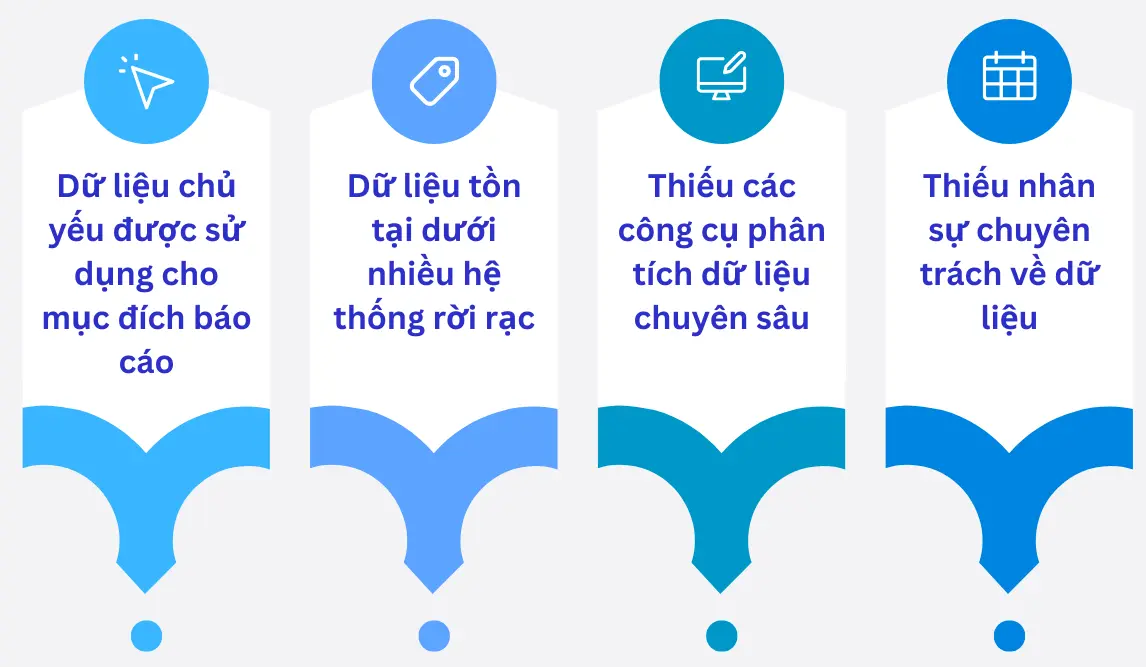
The data is primarily used for reporting purposes
In many businesses, data is primarily collected to serve periodic reporting or to meet internal management requirements. The analysis of data to detect trends or support strategic decision-making is still limited.
Data exists across multiple discrete systems
Customer, product, financial, and operational information is often located in various software or data files. This dispersion makes it difficult to aggregate and analyze the data.
Lack of advanced data analysis tools
Many businesses have not yet adopted modern data analysis tools such as management dashboard systems or advanced data analytics platforms.
Lack of dedicated data personnel
The data analysis capabilities of the HR team are still limited. In many cases, data is processed mainly using manual methods.
These factors lead to the situation where data exists within the enterprise but has not yet been effectively transformed into knowledge for management purposes.
Three major challenges in enterprise data management
Through research and practical implementation in many organizations, three main groups of challenges in data governance can be identified.

1. Distributed data and lack of connectivity
In many businesses, information systems are implemented in stages or by department. This leads to data being stored in various different systems such as:
- accounting system
- customer management software
- sales management system
- production management system
When these systems are not integrated, it will be difficult to leverage the data comprehensively.
2. Lack of data normalization
Another common issue is that data is entered and stored in various different formats. For example:
- the customer's name is recorded in various ways
- product code is not standardized
- inconsistent address or phone number information
This lack of standardization reduces the reliability of the data and complicates the analysis process.
3. Lack of long-term data strategy
In many cases, data collection and management have not been considered a part of the business development strategy.
Data is often processed based on short-term needs rather than being managed as a strategic asset.
This makes it difficult for businesses to build large-scale data analytics systems or deploy artificial intelligence applications in the future.
Approach to Developing Data Capabilities
To effectively leverage the value of data, businesses need to approach data management in a systematic way.

Building a data strategy
Businesses need to define the role of data in their long-term development strategy. This includes identifying: the types of important data, the goals for using data, and the data sources that need to be collected and managed.
Data strategy helps guide investment activities and the development of data infrastructure within the enterprise.
Data infrastructure development
An effective data infrastructure system needs to ensure: data is stored centrally, data can be easily accessed, data is secure and tightly managed.
Building a centralized data warehouse or data analytics platforms can help businesses leverage data more effectively.
Developing data analysis capabilities
In addition to technology infrastructure, the human factor plays an important role in data mining.
Businesses need to invest in: training data analysis skills for personnel, building a dedicated data team, and developing a data-driven culture within the organization
When personnel have the ability to understand and use data, data truly becomes a tool for decision-making support.
Implications for businesses in the upcoming period
In the context of increasing competition, data mining capabilities will become one of the key factors determining a company's competitive ability.
Businesses that can effectively collect, analyze, and utilize data will have many advantages in: understanding customer needs, optimizing operational activities, and identifying new business opportunities
On the contrary, businesses that do not invest in data capabilities may struggle to adapt to market changes.
Therefore, building data capabilities is not just a technological issue but also an important shift in the management mindset of the business.
In the context of increasing competition, data mining capabilities will become one of the key factors determining a company's competitive ability. Companies that can effectively collect, analyze, and utilize data will have significant advantages in understanding customer needs, optimizing operational activities, and identifying new business opportunities. Conversely, companies that do not invest in data capabilities may struggle to adapt to market changes.
Therefore, building data capabilities is not only a technological issue but also an important shift in the management mindset of businesses. In practice, many companies need support from organizations with expertise in data and digital transformation to develop a roadmap that suits their conditions and resources. As the Institute for Research on Organizations and Digital Economy, which is implementing research, training, and consulting activities on data, AI, and digital transformation for organizations and businesses, the analyses in this article also aim to provide additional perspectives and reference points to help businesses gradually develop their data capabilities and enhance management effectiveness in the context of the digital economy.