
With the goal of providing practical knowledge and specific application skills, helping employees understand and utilize AI tools in their daily work. To ensure quality and practicality, NAMI has invited experts from the Institute for Research on Organizations and Digital Economy (RIDE) to serve as the training unit.

Practical training content
The training session went straight into the specific operations of the two departments instead of just presenting general theory. For the Marketing department, RIDE experts provided hands-on guidance on how to use generative AI to quickly create content, from advertisements to script ideas. Additionally, solutions for analyzing customer data to personalize campaigns and marketing automation tools were also introduced.
For the Human Resources department, the content focuses on optimizing the recruitment process. Experts presented how AI helps automate the screening of candidate resumes, saving significant time. Additionally, solutions for automating administrative tasks such as timekeeping, payroll processing, and using AI to analyze performance in order to develop talent retention strategies were also discussed in depth.
The lively atmosphere mixed with questions
The atmosphere of the working session was very open, practical, and highly collaborative. The NAMI team proactively shared the difficulties they faced in their operations while actively asking questions to better understand how technology could support the specific tasks of each department. The RIDE experts took the time to listen to each specific issue, analyze the context, and provide suggestions for technological solutions that were suitable for NAMI's scale and existing resources. Thanks to this two-way exchange, the working session not only focused on knowledge training but also opened up practical application directions, helping NAMI to implement AI in a feasible and effective manner right from the initial stage. Therefore, the discussion became an important foundation for both parties to continue deeper collaboration in the future.
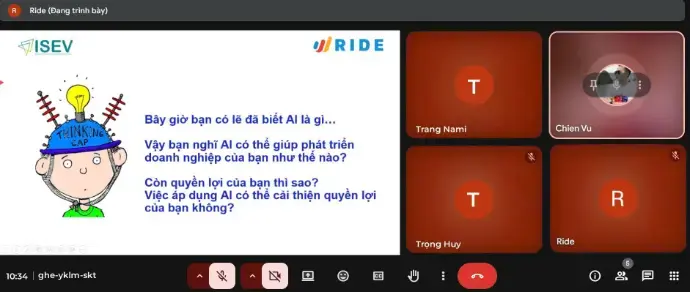
At the end of the training session, the NAMI team had a clear roadmap to begin applying AI to specific tasks in each department. Not only did they grasp how to operate the new tools, but each member also understood the improvement opportunities that could be implemented right in their daily work. This working session thus became an important stepping stone, helping NAMI proactively innovate and optimize internal processes. It also serves as evidence of the company's efforts and vision in integrating technology into key departments to enhance overall performance. More importantly, it creates a solid foundation for NAMI to continue developing more powerful AI solutions in the future.